Each mode's symmetry is denoted as dI, it has a degeneracy d, and transforms as an irrep I of the Skyrmion's symmetry group. We use the notation of Cotton. Character tables may be found here.
The zero modes are translations, rotations and isorotations. These decompose as 3T1g, 3T1u and 1A2g + 2Eu respectively.
| Freq. | Symmetry | Description/Notes | Visualization |
|---|---|---|---|
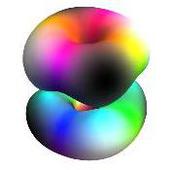
| 0.46 | 2Eg | Two opposite faces pull away from each other to form two B=2 tori. In the other direction, four edges pull away to become four B=1 Skyrmions. |

|
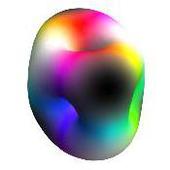
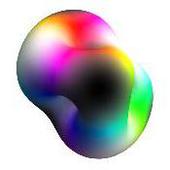
| 0.48 | 3T2g | An opposing pair of square-symmetric faces deform to become rhombus shaped. |
|
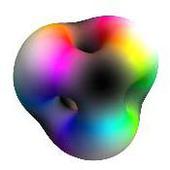
| 0.52 | 1A2u | Four vertices of the cube pull away, retaining tetrahedral symmetry. These then come in again and the other four vertices pull away to form the dual tetrahedron. |
|
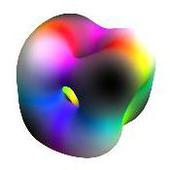
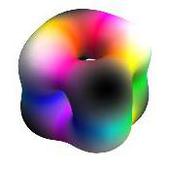
| 0.62 | 3T2u | Two opposite edges from the same face pull away from the origin. On the opposite face, the perpendicular edges also pull away. |
|
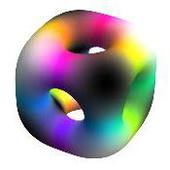
| 0.87 | 1A1g | The breathing mode. |
|
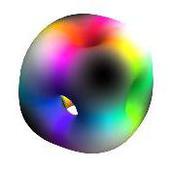
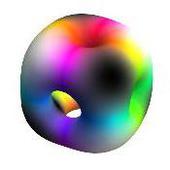
| 0.87 | 3T1u | One face inflates while the opposite face deflates. |
|
| 0.94 | 3T2g | Two opposite faces isorotate in opposite directions. |


|
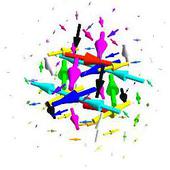
| 1.14 | 3T2u | Four vertices (all lying in a plane that also goes through the origin) isorotate clockwise around the red/teal axis. The other four isorotate anti-clockwise. This is easiest to see by examining the pion fields in detail, as shown in the second figure. |

|
Notes
Hover over an image (or if you're on a tablet/phone: tap on an image) to make it come to life. The hover-over text tells you the Cartesian realization of the element of the irrep you are looking at.